Single vs Twin Outboards: Cost, Safety, Manoeuvrability and Fuel Compared
- Twins roughly double engine servicing — two oil changes, two gearcases, two impellers — and add a second purchase price up front.
- The real case for twins is redundancy offshore and docking control, not top speed.
- At a steady cruise, twins sharing the load often burn fuel close to one larger single. The gap appears at idle and trolling speeds.
- A single engine with a small auxiliary kicker is the value pick for smaller boats that fish more than they travel.
- Your capacity plate and transom decide first: never exceed the rated maximum horsepower or weight, however the power is split.
One big engine or two smaller ones? It is one of the oldest arguments in boating, and it survives because both sides are right — for different boats, different water and different owners. A single 300 and a pair of 150s make the same headline horsepower, but they behave like different machines at the dock, on the service invoice and thirty miles offshore with a storm building.
This guide compares the two rigs honestly, line by line. If you are pricing a boat change at the same time, our repower guide covers the hull and rigging checks that come first, and our horsepower guide helps you fix the total power figure before you decide how to split it.
The cost reality: two of everything
Start with the invoice, because it frames everything else. A twin installation means two engines, two propellers, two sets of controls or a dual control, two harnesses and, on digital setups, two lots of rigging. The pair usually costs more than the single bigger engine of equal total horsepower, and installation labour rises with every extra component.
Maintenance follows the same maths for the life of the boat. Every scheduled service doubles its engine-specific items: two oil and filter changes on four-strokes, two gearcases to drain and refill, two impellers, two sets of spark plugs, two fuel filters. Parts that belong to the boat rather than the engines — steering, batteries, hull gear — stay single. Plan on routine engine servicing costing close to twice the single-engine figure.
None of that makes twins a bad buy. It makes them a deliberate one: you are paying a known premium for the benefits below, worth it only if your boating actually uses them.
Redundancy: the offshore safety case
The strongest argument for twins is not performance — it is the second engine as a lifeboat. An engine can stop for reasons that have nothing to do with its quality: a failed starter, a clogged filter, a propeller strike, an electrical fault. With twins, most of those failures demote you to one engine and a slower trip home. With a single, the same failure means a radio call and a tow.
Two qualifications keep this honest. First, twins share systems: both usually draw from the same fuel tank, so contaminated fuel — the classic offshore stopper — can silence both. Redundancy protects against engine-specific failures, not shared ones. Second, getting home on one engine depends on the boat and its props: a pair is propped for both engines together, so one engine alone, pushing the whole boat, will work hard and may only manage displacement speed or a slow plane. That is still a self-rescue — just a long, slow one.
For boats that regularly run well offshore or fish remote water, that margin is the whole point — and why serious offshore centre consoles are rigged with twin and multi-engine sets as a matter of course.
Manoeuvrability: where twins earn their keep at the dock
Around the marina, twins are simply easier. Two engines spaced apart on the transom can be worked against each other — one in forward, one in reverse — to walk the boat sideways, spin it in its own length and hold it against wind and current while lines are handled. A single answers the same conditions with throttle bursts and wheel work: a skill, not a defect, but one that has to be rebuilt in every new crosswind.
Modern joystick piloting systems build on that twin-engine geometry, merging throttle, shift and steering into one control for docking. They exist only on multi-engine rigs, and they lower the stress of close-quarters work enormously — at the price of still more electronics in the rigging bill. Even without one, many skippers say twins justify themselves the first time they dock single-handed in a gusty marina.
Draft, weight and transom space
Twins spread their weight across the transom instead of concentrating it in one heavy unit, but their combined weight is usually greater than one large engine of the same total power. Check the total against your capacity plate and watch how the boat sits at rest: scuppers near the waterline and a stern-heavy attitude are the usual tells of too much transom weight.
Draft cuts both ways. A single's one lower unit can be tilted clear in very shallow water, and one prop is cheaper to replace after a grounding. Twins put two lower units in the water, mounted further outboard where the hull's deadrise is shallower — on many hulls each sits slightly higher than a centre-mounted single would, but there are two of them to protect. Swim platforms, ladders and transom doors also compete for the space twins need: measure the transom before falling for a pair.
Fuel burn: the nuance most comparisons get wrong
The dockside claim that twins burn twice the fuel is wrong, and so is the claim that there is no difference. The truth sits in the throttle. At a steady cruise, propulsive demand is set by the boat, not the engine count: the hull needs a certain amount of power to hold 25 knots, and two engines each supplying half of it burn, between them, roughly what one engine supplying all of it burns. A single asked for the same total power through one propeller carries higher loading on that one prop, which costs efficiency.
The differences show up at the ends of the throttle. At idle and trolling speeds, two engines running burn more than one — which is why twin-rigged trolling boats often shut one engine down and fish on the other. At wide-open throttle, two gearcases drag more than one, and the single usually wins on top speed per horsepower. Over a season of mixed use, the fuel gap between equal-power rigs is far smaller than the maintenance gap.
When a single plus a kicker wins
There is a third option that beats both on the right boat: one main engine sized for the boat, plus a small auxiliary — a kicker — of roughly 8 to 15 horsepower on a bracket. The kicker trolls at a fraction of the main engine's fuel burn, keeps trolling hours off the expensive engine, provides get-home power at displacement speed after a main-engine failure, and costs less to buy and service than a second full-size engine. For trailer boats under about 23 feet fishing lakes, rivers and nearshore water, it is often the rational rig.
The kicker's limits are pace and conditions: it will not plane the boat or spin it around a marina the way twins do. On a genuinely offshore boat it is a trolling accessory, not a redundancy plan.
So, single or twins?
Choose a single when the boat is trailered and size-limited, when budgets matter, when your water is protected or help is close, and when shallow draft is a priority. Choose twins when you run offshore regularly, dock in tight or windy marinas, want joystick-class low-speed control, or refuse to let one failed starter end a trip forty miles out. Choose the single plus kicker when trolling is the main event and a slow ride home is an acceptable worst case. However you split it, the total must respect the capacity plate.
Shop the motors in this guide
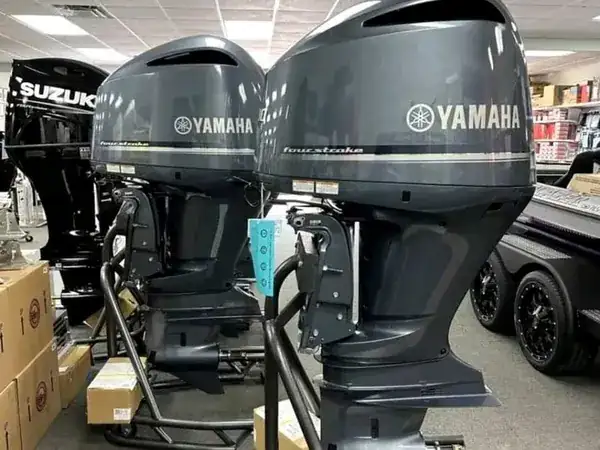 New — 2023 Leftover
New 2023 Yamaha F300XA & LF300XA 300 HP Twin Pair — Full Accessories
- 2023
- 300 HP
- Brand new
- 25" shaft
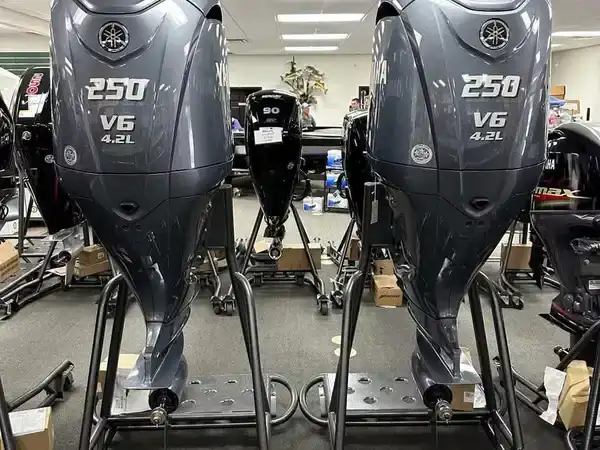 New
New Yamaha F250XCB & LF250XCB Twin Pair — DEC Controls, 25" Shafts
- 250 HP
- Brand new
- 25" shafts
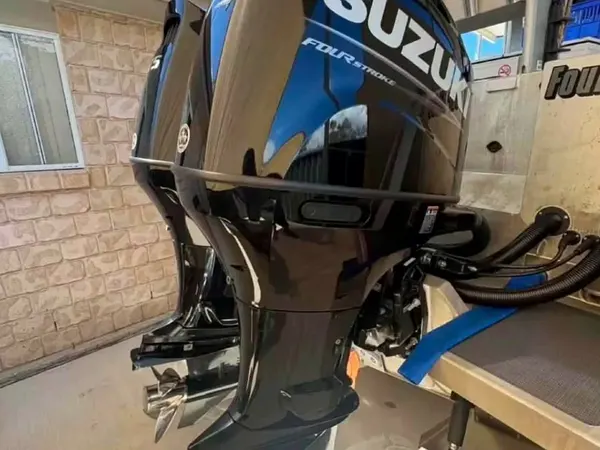 Pre-Owned
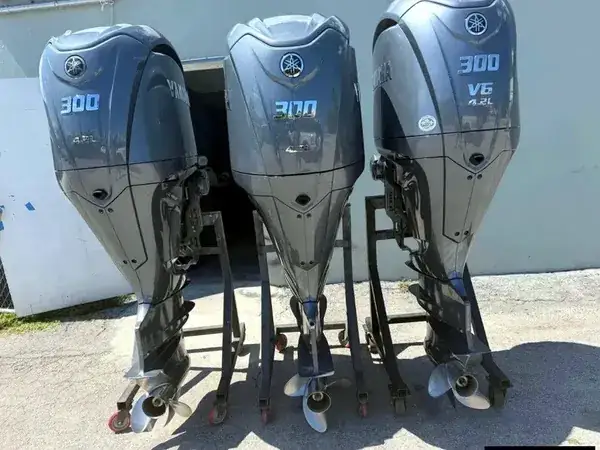 Pre-Owned
2023 Yamaha F300 EX Triple Set — Electric Steering, Rigging Included
- 2023
- 300 HP
- Triple set
- 30" shafts
 Used
 Pre-Owned
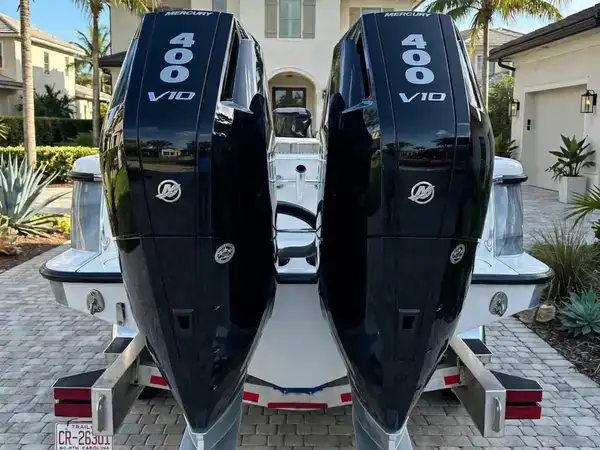
2024 Mercury 400HP V10 Twin Pair — 25" Shafts, 255 Hours, Warranty to 2027
- 2024
- 400 HP
- 255 hrs
- 25" shaft
Twin and multi-engine sets are listed as complete pairs and triples with their price, freight and deposit on each page. Comparing a single against a pair? Start from the twin and multi sets or the full inventory.
Frequently asked questions
Are twins twice as expensive to maintain as a single engine?
Close to it on engine-specific items. Each engine needs its own oil and filter changes, gear lube, impeller, spark plugs and fuel filters, so scheduled engine servicing on a twin rig budgets at roughly double the single-engine figure. Boat-level items — steering, batteries, hull maintenance — stay the same either way.
Can you really get home on one engine if the other twin fails?
In most cases, yes — at reduced speed. One engine has to push the whole boat on a propeller pitched for two, so expect displacement speed or a slow plane on a light boat rather than normal cruise. It is a genuine self-rescue capability, just a slow one, and it does not protect against shared failures such as contaminated fuel from the common tank.
Do twin outboards use twice as much fuel as a single?
No. At a steady cruise the hull demands a fixed amount of power, and two engines each supplying half of it burn roughly what one engine supplying all of it burns. Twins burn more at idle and trolling speeds with both engines running, and a single usually has a small edge at wide-open throttle because it drags one gearcase instead of two.
Is a single outboard safe enough for offshore fishing?
A well-maintained modern single is a reliable engine, and plenty of boats fish offshore on one. The question is consequence, not probability: offshore, an engine-specific failure on a single means a tow, while on twins it usually means a slow trip home. Distance from help, sea conditions, communications gear and maintenance discipline should drive the decision.
What size boat needs twin outboards?
There is no fixed threshold. Twins make sense when the power needed approaches what the largest practical single offers, when the hull was designed for a pair, or when the boat's use — regular offshore runs, heavy loads, tight docking — values redundancy and manoeuvrability over cost. The capacity plate's horsepower and weight limits always govern the total.
Related guides
- Repowering your boat: when it makes sense, what it costs, and what to check
- What horsepower outboard motor do I need?
- Propellers explained: pitch, diameter, blades and material
Talk to a specialist
Weighing a single against twins for your boat? Call +1 754-251-4847 or request a quote with your boat model, capacity-plate limits and how you use it. Browse twin and multi-engine sets or the full inventory to see both rigs side by side.